UF Institute of Food and Agricultural Sciences logo
Give      University of Florida
Resources
    Toggle Search Form
    GIVE UNIVERSITY OF FLORIDA
    • HOME
    • Research
        • Topics
        • Dissertations and Theses
    • Teaching
    • Biocomplexity Seminar Series
    • Software
    • VFSMOD
        • Item 1
        • Item 2
        • Item 3
        • Item 4
        • Item 5
        • Item 6
        • Item 7
        • Item 8
        • Item 9
        • Item 10
        • Item 11
        • Item 12
    • Publications
        • Item 1
        • Item 2
        • Item 3
        • Item 4
        • Item 5
        • Item 6
        • Item 7
        • Item 8
        • Item 9
        • Item 10
        • Item 11
        • Item 12
    • People
        • Item 1
        • Item 2
        • Item 3
        • Item 4
        • Item 5
        • Item 6
        • Item 7
        • Item 8
        • Item 9
        • Item 10
        • Item 11
        • Item 12

    ABE Hydrology and Water Quality Program

    ABE Hydrology and Water Quality Program

    Research Topics


    Modeling Vegetation Dynamics in the Everglades

    Research Topics


    Modeling Vegetation Dynamics in the Everglades

    Participants: Gareth Lagerwall, Gregory A. Kiker, Rafael Muñoz-Carpena, Andrew James, Naiming Wang, Kirk Hatfield

    Timeline: May 2006 – August 2010

    Project Summary

    The focus of The Comprehensive Everglades Restoration Plan (CERP) is slowly shifting from "getting the water right", towards maintaining and improving the ecology that is impacted by the water. To this end an integrated, spatially explicit, ecological model would serve to predict the impact of various management decisions on the environment.

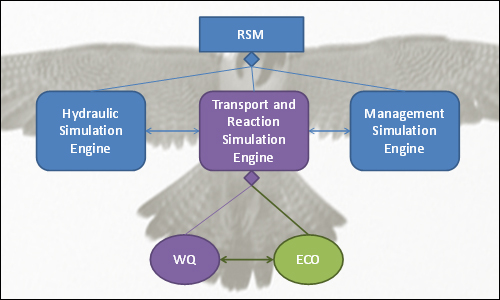
    Typha domingensis (Cattail) is known as an invasive, as well as an indicator, species. As such it was decided to model the dynamics of this sedge within the Water Conservation Area 2a (WCA2A), which is fairly representative of the everglades proper. The Transport and Reaction Simulation Engine (TARSE) was originally developed as a water-quality module to be incorporated within the Regional Simulation Model (RSM) - which can model the flow of water throughout South Florida. The TARSE code was used, and extended to incorporate ecological components (TARSE:ECO).

    Cattails will be deterministically modeled with four increasing levels of complexity, with the idea that each successive level will better approximate the raw data provided. Having user-definable inputs and interactions, it is expected that TARSE:ECO will adequately simulate any ecological species (within the confines of the grid size) with as much or as little detail as desired.
    Resource Links

    • The Comprehensive Everglades Restoration Plan (CERP)
    • Regional Simulation Model - South Florida Water Management District
    • Regional Simulation Model - Water Quality - South Florida Water Management District
    • South Florida Water Management District (SFWMD)
    University of Florida Logo
    Contact

    Feedback
    Hydrology & Water Quality
    1741 Museum Road, Gainesville, Florida 32611-0570
    (352) 294 - 6747

    Land Grant Mission
    • Teaching
    • Research
    • Extension
    Information
    • Ask IFAS (EDIS)
    • UF/IFAS Experts
    • UF/IFAS Blogs
    • UF/IFAS Bookstore
    Policy
    • Accessible UF
    • EEO Statement
    • IFAS Web Policy
    • SSN & UF Privacy
    • Analytics (Google Privacy)

    © 2025 University of Florida, IFAS Last Modified:Fri, 27 Mar 2026 13:24:52 EDT