UF Institute of Food and Agricultural Sciences logo
Give      University of Florida
Resources
    Toggle Search Form
    GIVE UNIVERSITY OF FLORIDA
    • HOME
    • Research
        • Topics
        • Dissertations and Theses
    • Teaching
    • Biocomplexity Seminar Series
    • Software
    • VFSMOD
        • Item 1
        • Item 2
        • Item 3
        • Item 4
        • Item 5
        • Item 6
        • Item 7
        • Item 8
        • Item 9
        • Item 10
        • Item 11
        • Item 12
    • Publications
        • Item 1
        • Item 2
        • Item 3
        • Item 4
        • Item 5
        • Item 6
        • Item 7
        • Item 8
        • Item 9
        • Item 10
        • Item 11
        • Item 12
    • People
        • Item 1
        • Item 2
        • Item 3
        • Item 4
        • Item 5
        • Item 6
        • Item 7
        • Item 8
        • Item 9
        • Item 10
        • Item 11
        • Item 12

    ABE Hydrology and Water Quality Program

    ABE Hydrology and Water Quality Program

    Research Topics


    Colloid Filtration by Simulated Emergent Vegetation in Shallow Overland Flow

    Research Topics


    Colloid Filtration by Simulated Emergent Vegetation in Shallow Overland Flow

    Participants: Lei Wu, Bin Gao, Rafael Muñoz-Carpena

    Timeline: 2010 - 2013

    Project Summary

    Transport of suspended colloidal particles in water flow is an important contamination process that deteriorates surface and groundwater quality. Pathogenic biocolloids and abiotic colloid-toxicant complexes have shown high mobility in hydrologic pathways and received increased attention recently. Significant research efforts have been made in understanding colloid and colloid-facilitated transport in subsurface. However, our ability to predict colloid fate in surface runoff remains limited, especially with respect to their fate in overland flow with emergent terrestrial vegetation.
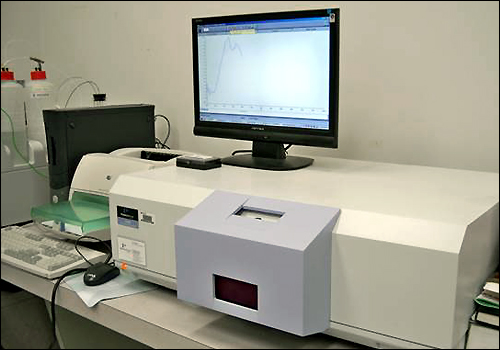
    Fluorescence Spectrometer (PerkinElmer LS45)

    There is a critical need to carry out a systematic theoretical and experimental examination to identify the fundamental mechanism of colloid transport through emergent terrestrial vegetation. Our long-term research goal is to develop a process-based mathematical model that can accurately predict the fate and transport of colloid in overland flow with emergent terrestrial vegetation. It is our central hypothesis that the stems of the terrestrial vegetation are the filtration collectors that capture colloidal particles from shallow overland flow to reduce their concentration in runoff. We plan to accomplish the objective and test our central hypothesis by systematically pursuing the following two specific objectives:

    1. Develop a theory for predicting single-collector efficiency of colloid filtration by emergent rigid plant stems in shallow overland flow.
    2. Conduct laboratory experiments on colloid transport through simulated emergent vegetation in shallow flow to test and refine the single-collector efficiency theory for plant stems.
    University of Florida Logo
    Contact

    Feedback
    Hydrology & Water Quality
    1741 Museum Road, Gainesville, Florida 32611-0570
    (352) 294 - 6747

    Land Grant Mission
    • Teaching
    • Research
    • Extension
    Information
    • Ask IFAS (EDIS)
    • UF/IFAS Experts
    • UF/IFAS Blogs
    • UF/IFAS Bookstore
    • Careers
    Policy
    • Accessible UF
    • EEO Statement
    • IFAS Web Policy
    • SSN & UF Privacy
    • Analytics (Google Privacy)

    © 2025 University of Florida, IFAS Last Modified:Fri, 27 Mar 2026 13:29:08 EDT